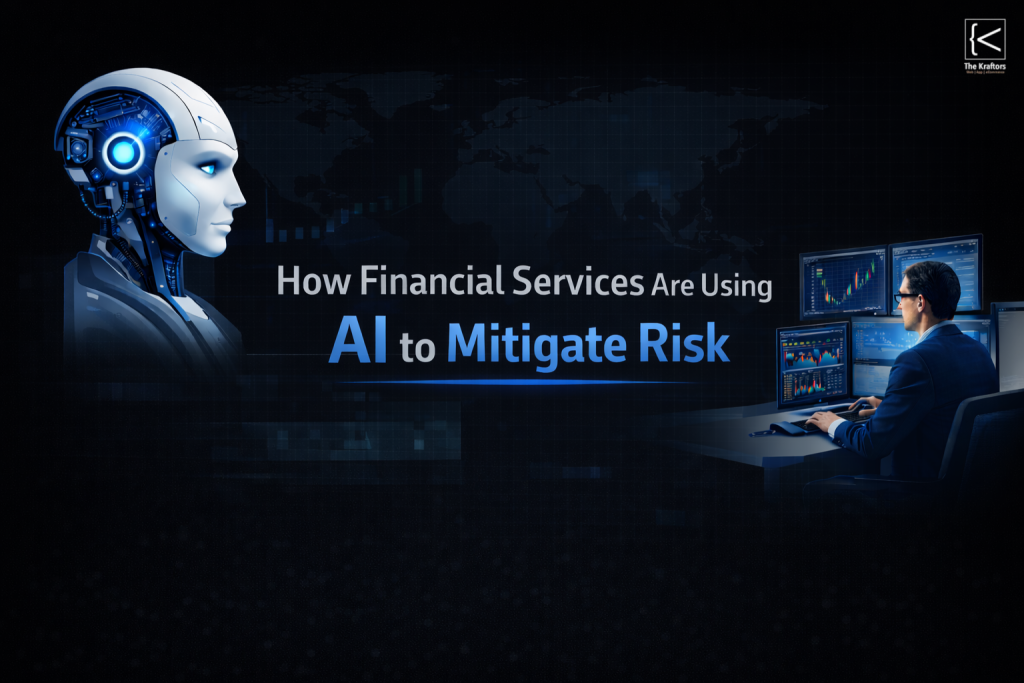

The digital transformation, increased customer demands and more complex risk environment are accelerating the growth of the financial services sector as never before. Fraud detection to credit scoring and regulatory compliance are only a few of the challenges that financial institutions have to deal with yet these cannot be fully addressed using traditional risk-management tools. The Artificial Intelligence (AI) is transforming the scene here. In the current times, AI is helping banks, insurance firms, and fintech companies, and investment institutions to identify risks at an earlier age, make even smarter decisions, and safeguard themselves and their customers.
This article discusses AI risk mitigation in financial services, the most important areas where AI is most valuable and why AI is increasingly becoming critical in modern financial operations.
1. AI Improves Fraud Prevention and Detection.
One of the largest threats in financial services is fraud. Manual monitoring is not possible with millions of transactions that take place each second. AI plays a central role in AI risk mitigation in financial services by enabling:
✔ Real-time anomaly detection
AI algorithms work in real-time and examine transaction trends, determine suspicious activity, e.g., a high-value purchase when an individual is not on vacation or a foreign account log in or strange spending habits. Machine learning models are constantly trained on new information, and they enhance their capability to identify fraud.
✔ Behavioral biometrics
Banks are rolling out AI systems that employ distinctive user behavior, e.g. typing speed, device usage, and navigation patterns. Deviation will give an alert, and prevent fraud before it occurs.
✔ Reduced false positives
Conventional fraud tools have a tendency of blocking authoritative transactions. Accuracy via AI has better false alarms and enhanced customer experience.
Consequently, AI-based fraud detection systems are assisting financial institutions in saving billions of dollars every year.
2. AI enhances Lending Decision and Credit Scoring.
The conventional ways of credit scoring are overly dependent on fixed-time information, such as bank statements, repayment records, and credit reports. However, these models do not usually describe all the financial behavior of a borrower.
AI changes the assessment of credit risks in a number of ways:
✔ Using alternative data
AI considers a broader variety of data, including:
- Digital payment behavior
- Transaction patterns
- Employment history
- Cash flow data
- Social behaviour indications (where allowed)
This leads to better credit evaluations and serves people with scarce credit records by the financial institutions.
✔ Real-time risk evaluation
Machines that use AI to determine the creditworthiness of a customer instantly can accelerate the process of loan approvals and maintain high risk management.
✔ Predictive scoring models
Machine learning estimates the likelihood of default, enabling the lenders to offer improved terms, interest rates, and the loan limit.
This renders AI necessary in safer and inclusive lending.
3. AI Enforce Regulatory Compliance (RegTech).
The financial industry is highly regulated, and its compliance policy is becoming increasingly intricate every year. AI assists organizations to control their compliance risk better by:
✔ Automated monitoring
AI can examine thousands of transactions, documents and interactions to identify possible compliance violations or suspicious activities.
✔ AML and KYC automation
AI ensures that identities are verified, that there are no abnormalities in the data of a customer and that money laundering is being tracked more precisely than when using manual verification.
✔ Smart document management.
Autonomous AI powered tools are used to extract, verify and classify regulatory data, and AI-based interfaces have a significant impact on human error reduction.
Financial institutions can evade sanctions, safeguard customers, and be transparent by using AI in compliance systems.
4. AI Enhances Risk in Investment.
Artificial intelligence in the field of investment banking and wealth management is used to forecast and make well-informed decisions regarding the market risks.
✔ Market trend predictive analytics.
Artificial Intelligence compares the international markets statistics, economic factors, and past trends and makes projections of risks and plans investment.
✔ Portfolio risk analysis
AI models help identify:
- Overexposed sectors
- Volatile assets
- Liquidity risks
- Diversification gaps
This will allow advisors to build more resilient and safer portfolios.
✔ Algorithmic trading
The AI trading systems are more responsive to human reaction cycles, minimizing losses through trading at the most appropriate time, and preventing risky trades.
In the case of AI, investment companies amplify returns, and they decrease the risk of exposure to market fluctuations.
5. AI Improves the Operational Risk Management.
Financial institutions can be derailed by operational risks which include system downtime, human error or process failures. These risks can be minimised with the help of AI:
✔ Predictive maintenance
AI will also predict failures in systems before they happen and this minimizes the downtime of the system as well as enhancing the reliability of the system.
✔ Workflow automation
Routine operations such as data entry, verification and reporting are automated by AIs, thereby making operations accurate and efficient.
✔ Risk heat-mapping
AI tools provide specific information on risk areas that are likely to be experienced in an organization. This assists the leaders in making preventive actions earlier.
6. Artificial Intelligence Enhances Finance Cybersecurity.
There are rising frequencies and severity of cyberattacks. To identify threats more quickly than conventional systems, financial institutions apply AI-generated cybersecurity tools.
✔ Smart threat identification.
AI recognizes suspicious network activity- indicators of malware, phishing or unauthorized access.
✔ Automated incident response.
With AI systems, compromised servers or accounts can be isolated in real-time and the attack may be minimized.
✔ Continuous monitoring
AI is 24/7, which is not the case with human beings.
This renders AI to be indispensable in the current financial cybersecurity approaches.
Summary: AI-Driven Risk Mitigation in Financial Services
AI is not a technology of the future, it is transforming the way financial institutions do business. From fraud detection and credit assessment to compliance, investment analysis, and cybersecurity, AI risk mitigation in financial services enables faster, smarter, and more proactive decision-making..
With the world becoming increasingly intricate in the financial field, companies implementing the use of AI in risk mitigation policies will gain a high competitive edge. It can be a bank seeking to minimize fraud losses or a fintech company seeking to simplify credit assessment; the intelligence, precision, and speed that the current financial landscape requires can be found in AI.