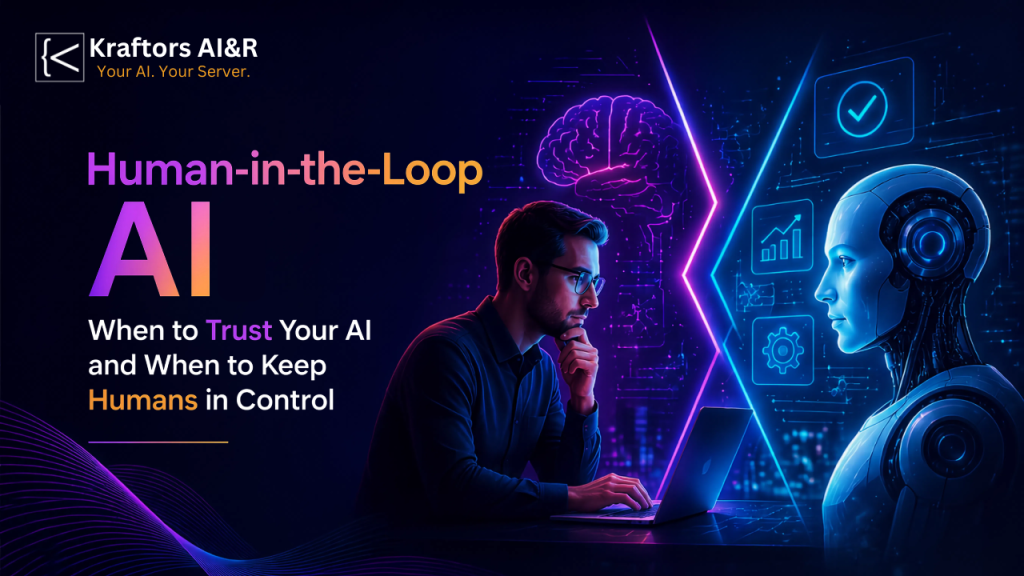

Artificial intelligence is transforming how businesses work—but should AI make every decision on its own?
The answer is no.
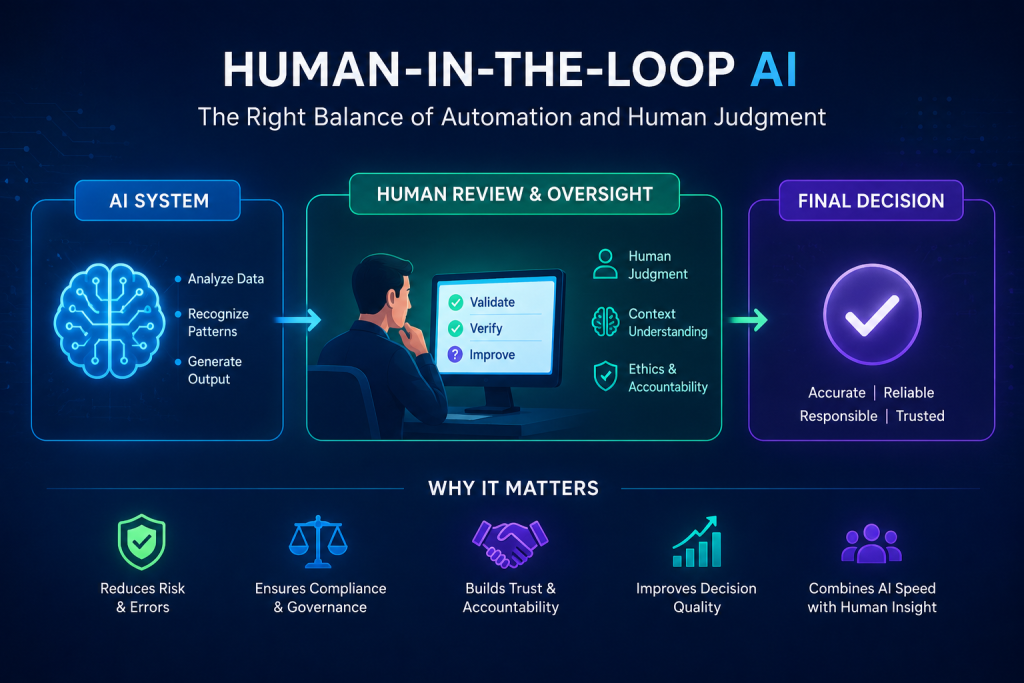
For enterprise applications, the most reliable approach is Human-in-the-Loop AI (HITL AI), where AI handles speed and automation while humans provide judgment, oversight, and final validation when it matters. This balance creates trustworthy AI systems that are accurate, accountable, and aligned with business goals.
What Is Human-in-the-Loop AI?
Human-in-the-Loop AI (HITL AI) is an AI system where people review, approve, or correct AI-generated decisions before critical actions are taken.
Instead of replacing humans, Human-AI collaboration combines machine intelligence with human expertise to improve decision-making, reduce errors, and strengthen enterprise AI governance.
Why Human Oversight Matters in Enterprise AI
AI can process vast amounts of data in seconds, but it can still make mistakes, inherit bias, or misinterpret context.
That’s why human oversight in AI is essential for:
- High-risk business decisions
- Financial approvals
- Healthcare recommendations
- Legal document reviews
- HR hiring decisions
- AI-generated content validation
The higher the risk, the greater the need for AI decision-making with human oversight.
When Can Enterprises Trust AI?
AI can operate with minimal supervision for repetitive, low-risk tasks such as:
- Data classification
- Customer support automation
- Document summarization
- Workflow automation
- Predictive analytics
These tasks benefit from automation while maintaining quality through periodic monitoring.
When Humans Must Stay in Control
Human review becomes critical when AI decisions can impact people, finances, compliance, or brand reputation.
Examples include:
- Approving loans
- Medical diagnosis support
- Legal compliance reviews
- Recruitment decisions
- Cybersecurity incident response
- Enterprise risk assessments
This is where Human-in-the-Loop AI for enterprises delivers the greatest value.
Human-in-the-Loop AI vs Fully Autonomous AI
| Human-in-the-Loop AI | Fully Autonomous AI |
| Human validation before critical decisions | AI acts independently |
| Higher accountability | Higher operational risk |
| Better compliance | Limited oversight |
| Easier to build trust | Difficult to explain decisions |
For most enterprises, the future isn’t AI replacing humans—it’s AI augmenting human intelligence.
Best Practices for Responsible AI Implementation
To build secure and reliable AI systems, organizations should:
- Create a strong AI governance framework
- Define clear human review workflows
- Monitor AI performance continuously
- Conduct regular AI risk assessments
- Ensure AI transparency and explainability
- Maintain compliance with evolving AI regulations
These practices improve AI accountability, reduce risk, and support long-term enterprise adoption
Final Thoughts
The question isn’t whether businesses should trust AI—it’s when they should.
The most successful organizations combine automation with human-in-the-loop AI, allowing AI to accelerate work while humans provide judgment where it matters most.
As enterprise AI adoption grows, companies that invest in AI oversight, responsible AI governance, and human-AI collaboration will build more reliable, compliant, and trustworthy AI systems.
Need help implementing enterprise AI responsibly? Partner with an experienced AI consulting company to design secure, scalable, and human-centered AI solutions that balance automation with human expertise.