
Introduction
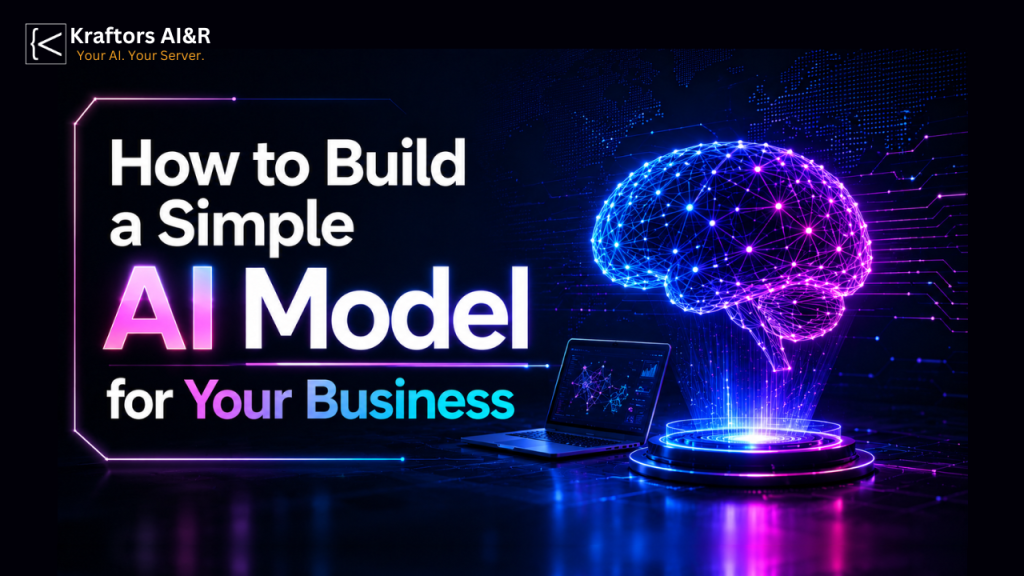
If you’ve been wondering how to build an AI model for business, you’re not alone. A lot of business owners today feel like AI is either too complex or too expensive to even try. But honestly? That’s changing fast. You don’t need a huge tech team or a massive budget anymore. With correct guidance, even smaller businesses can understand how to build an AI model for business and successfully implement it.
Let’s break it down – simply and practically.
Role of artificial intelligence in your business?
Before learning how to build an AI model for business let’s first understand the importance of an AI model for your business.
Advantages of AI model
- Saves Time: AI models can automate repetitive tasks and can complete them in seconds, which can take hours when done manually.
- Cost Optimization: Investing in AI models can have higher setup cost , but in longer runs, it reduces human errors and also cuts down labour expenses.
- Smarter Decisions: AI models can learn from large datasets and understand the patterns which can automate tasks and also helps to find patterns that humans may not have noticed.
- Competitive Edge: Business with AI models adjust rapidly to the changing market dynamics and thus outperform the competition.
Step 1 — Establish a clear Objective
The journey of how to build an AI model for business starts by identifying and establishing a clear business – objective.
Be Precise: Your problem statement should be clear, precise and should not be vague. A well-stated problem not only simplifies the process but also helps in tracking results.
Check Feasibility: Make sure that the objective is viable and not impractical. Also ensure whether necessary data is priorly available
Collaborate and Discuss: Encourage users of the AI to engage in collaborative conversations. This will not just provide a clear idea of the process but also help create realistic objectives.
Step 2 – Collect and Organise Data
The data is the backbone of all AI models and is also the first step in deciding how to build an AI model for business. Bad data equals bad forecasts.
Find Your Sources: Integrate data from your CRM, site analytics, sales data, or customer feedback.
Collect Enough Data: For most simple models, a few hundred to thousands of examples is required for learning.
Clean It Up: Detect, correct and fill in missing data. Clean data trains better models.
Assess Outcome: Accuracy and uniformity of the training data is important for successful outcomes. Biased data will affect the accuracy of outputs.
Segmentation: Divide the data into two sets. One is the training set – 80% (for training the model) and another is the testing set – 20% (for testing the model).
Step 3 – Find the most optimal tool for your requirement
Don’t start from Zero, leverage the pre-existing resources. There are many tools available that can help you do this
Python and Scikit-learn: Popular open source choice. Very helpful to beginners who are working with classification or regression tasks.
Google AutoML: A no code platform – upload your data and Google will train the model for you.
Microsoft Azure AI: Pre-designed models and drag-and-drop interface to create custom training.
Amazon SageMaker: Best suited for the AWS customer. Is able to support the complete life cycle of model development.
Step 4 – Train and test your model
The process of training a model involves feeding it your data and allowing it to identify, recognise and learn the pattern. Testing and refining the model makes it future-proof.
- Split your data: Don’t use your entire data-set just for training, instead divide it into 80% and 20%. Use the part with 80% data for training and another part with 20% data for testing. This way the model will give unbiased results.
- Start simple: Don’t take up complex algorithms when it’s not needed. Start working with a simple model and gradually move forward. The whole idea behind starting simple is that – A simple model that gives appropriate results is better than a complex model that doesn’t.
- Check your results honestly: Look at where the model gets it wrong by testing it on new data. Checking and correcting the errors will make the model future-proof.
Step 5: Deploy and Monitor
Building the model live is not the finish line – it’s the starting point.
Integrate with existing tools: The model needs to integrate with the tools your team already uses (CRM tool, website and inventory system. Seamless integration is very crucial for smooth operation and people often are stuck at this when they first figure out how to build an AI model for business.
Monitor performance regularly: Business conditions change and thus the data evolves over time. Old models may not give appropriate results on the new data. Plan to retrain it periodically.
Get feedback from your team: The people using it every day will notice problems faster than any dashboard will.
Common errors and pitfalls
A lot of businesses fail from the get-go. Beware of these typical mistakes!
- No Clear Goal: The act of jumping to tools before stating the problem is time and money wasted.
- Bad Data: The best algorithm will not correct bad data.
- Overcomplicating It: A simple model that works is better than a complex model that doesn’t.
- No Ongoing Monitoring: Even the best models become obsolete very fast if they are not trained regularly.
Why Choose Kraftors
If this process still sounds complex, Kraftors simplifies the journey. Kraftors is a technology company that provides bespoke web solutions and AI models that are custom-built for businesses. You don’t have to face this alone, you have a team of experts to handle the whole process.
- Goal-First Consultation: Kraftors starts with an understanding of your business and what exactly your business needs to do.
- Custom-Built Models: No off-the-shelf tools. Kraftors develops artificial intelligence models for your data, specific needs and industry.
- Full-Service Delivery: In the era of data preparation and model training through deployment, Kraftors does it all, the entire process.
- Seamless Web Integration: The AI model is embedded into your website or web app by Kraftfors with minimal disruption.
- Ongoing Support: As your business grows, Kraftors watches and provides retraining of your model as the data evolves.
With the help of the above, the solution to how to build an AI model for business is much easier. With Kraftfors’ expertise on your side you can stay focused on growing your business while we simplify the AI journey for you.
Conclusion
It doesn’t need to be a complex process for How to Build an AI Model For Business. Develop your problem, collect the necessary clean data, select appropriate tools, train, test and monitor. Begin small, learn quickly, expand what’s effective. And if you wish to get proficient assistance every step, Kraftors is prepared to construct it with you.