
Every technology company claims to harness AI. Every headline invokes machine learning. Yet almost no one explains the Artificial Intelligence vs machine learning difference — and that gap quietly costs you the clarity to separate genuine innovation from marketing noise. Grasping the AI vs machine learning difference is where it all starts.
The Core Difference Behind Smart Innovation
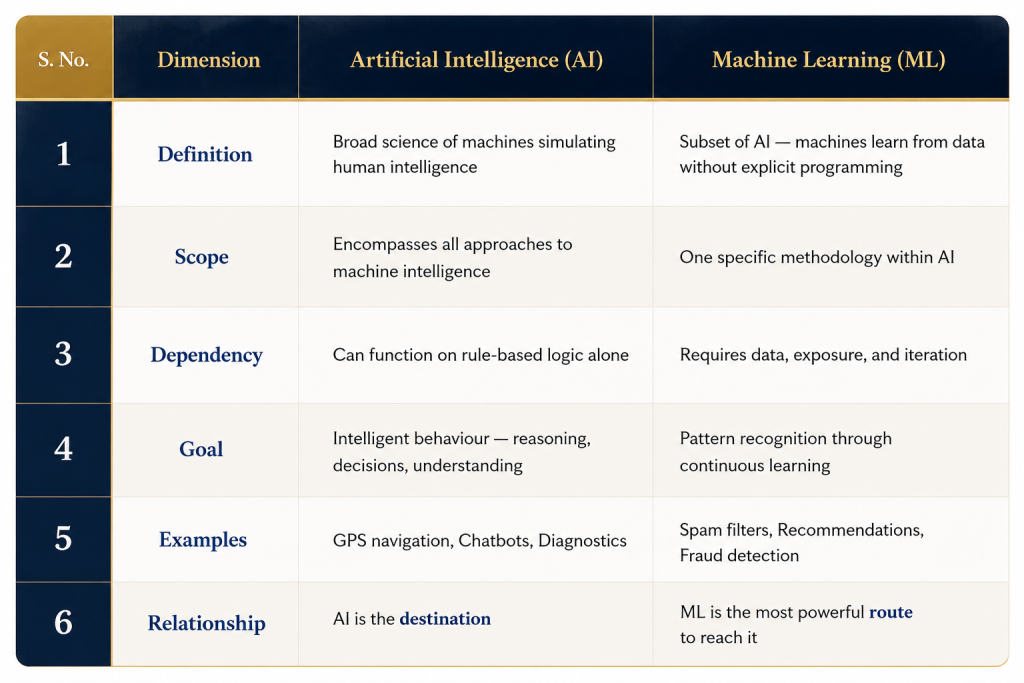
The clearest way to frame the AI vs machine learning difference: AI is the destination — machines capable of reasoning and acting with human-like intelligence. Machine Learning is the most powerful route to reach it. Every instance of ML is a form of AI, but AI existed long before ML became its dominant engine. One is the goal; the other is the means. Businesses are increasingly adopting AI development services to automate processes and improve decision-making.
AI vs Machine Learning Difference
Here is the AI vs machine learning difference laid out side by side:
What Is Artificial Intelligence?
Creating Intelligent Agents
The creation of systems that mimic tasks that require human reasoning such as understanding language, interpreting images, and navigating complex decisions is what the creation of these systems is referred to as AI. The field originated in the 1950s with inflexible, hand-written rules: if X, return Y. Rigid and not adaptable. This was the beginning of the Artificial Intelligence vs machine learning distinction: the traditional AI was rule-based, but the modern AI which is driven by the ML derives its rules.
The Potential of Modern AI
At present GPS applications are operating thousands of variables just to reroute you in real time. Hospital tools analyse scans with specialist-level precision. Chatbots handle thousands of queries at once. This range — from rule-followers to sophisticated learners — is exactly where the its difference matters most in practice. To learn more about Artificial Intelligence (AI), explore IBM’s detailed guide on AI.
What Is Machine Learning?
This is where the AI vs machine learning difference sharpens into something concrete.
Learning without rules
ML dispenses with fixed instructions entirely.It provides a system with data and enables it to determine patterns – improving itself in the process as it gets more and more examples. This is where the difference between AI and machine learning lies: the former can work with the help of rules only; the latter cannot as it requires data, exposure, and iteration to work. Think of how a child learns to recognise dogs not from a rulebook, but from hundreds of real-world encounters.
Embedded in daily life
Spotify surfaces music you hadn’t searched for. Gmail’s spam filter catches phishing patterns no static rule could anticipate. Uber forecasts demand by neighbourhood in milliseconds. Each example illustrates the AI vs machine learning difference in action: the goal is intelligent behaviour (AI); the engine achieving it is continuous learning from data (ML). Google’s introduction to Machine Learning explains how systems learn from data without explicit programming.
Where Does Deep Learning Fit In?
A subsystem inside a subsystem
Deep learning is a processing method that uses layered neural networks – inspired by the human brain – to process images, audio, and language. It is a clean hierarchy: AI ⊃ Machine Learning ⊃ Deep Learning. It is a logical leap to locate deep learning in this structure, as an extension of the knowledge of the difference between AI and machine learning itself.
The Role of Deep Learning in the AI/ML Framework
Face ID, Google Translate, and the large language models are all based on deep learning. It tremendously increased what ML was able to do – going beyond structured data to images, sound, and language at close-to-human-ability levels. The AI vs machine learning difference became commercially significant precisely because deep learning gave ML its most powerful toolkit yet.
Three Scenarios That Turn AI vs ML from Theory into Reality
- Your Smartphone Voice Assistant: The AI is the system that listens and responds with human-like fluency.The ML is the one it is trained on-algorithms slowly becoming sensitive to your voice and habits. Deep learning converts acoustic signals into structured language. Three layers, one seamless experience; the AI vs machine learning difference defines where each layer ends.
- Online Banking and Fraud Detection: When your bank flags an unusual transaction, that is the AI vs machine learning difference in real time. The AI is the fraud prevention system; the ML is what taught it your spending patterns — your merchants, amounts, locations — so anomalies stand out immediately. Without continuous ML learning, the system would rely on blunt rules that miss far more.
- Healthcare Diagnostics: AI systems detect early-stage cancers in scans by training on hundreds of thousands of labelled images. This difference between AI and machine learning is not an academic one – it directly defines how many lives these tools can save.
Why Knowing AI vs Machine Learning Is No Longer Optional
The Truth Behind the AI Hype
Once a product is described as being AI-powered, it is telling you virtually nothing. The AI vs machine learning distinction places you in a position to question what matters: is this system actually learning based on data, or is it a fixed rule behind fancy branding?
Where AI Decisions Actually Matter
When the Algorithm Gets It Wrong, Real People Pay.In healthcare, rule-based systems miss patterns that machine learning catches — and missing them can cost lives. Financial institutions rely on these systems to stop fraud within seconds rather than discovering it too late. Meanwhile, in hiring, biased data can produce biased outcomes, and because an algorithm generated them, they may appear fair even when they are not.
Conclusion
The AI vs machine learning difference resolves into three truths: AI is the ambition — machines that think and act intelligently. ML is the methodology that brought that ambition closest to reality. Together they form an architecture — ML is the engine, AI is the vision. Every fraud alert, navigation reroute, and personalized recommendation has the AI vs machine learning difference quietly at work. The sharpest question you can bring to any intelligent system: is it truly learning, or merely following instructions?